Most chatbot ROI calculators multiply invented numbers by a wish: an industry average deflection rate, an assumed cost per ticket, a conversion uplift nobody measured on your store. A small store can measure three things honestly instead, and none of them need an attribution model. This guide covers what those three are, how to count them, and how to judge the result against what the assistant actually costs.
The three effects worth measuring
| Effect | How to measure it | What it is worth |
|---|---|---|
| Repeat questions removed | Count conversations answered without a person, by topic | Your hourly value times the time each would have taken |
| Answers at decision time | Count pre-purchase questions answered outside working hours | Judgement, against average order value |
| Content gaps surfaced | The unanswered-question list, and what you fixed | Real, and mostly invisible before you had the list |
The third is the one stores consistently underestimate. Each recurring unanswered question was already costing you conversations before the assistant existed; the difference is that now you can see it.
Measuring the first: hours not spent
- Take a month of conversations and count those that ended without a person.
- Group them by topic: delivery, returns, sizing, order status, stock.
- Subtract the ones nobody would have contacted you about anyway. A shopper idly checking the returns window at midnight would not have emailed; be honest here, because this is where calculators cheat.
- Estimate a minute count for what remains, using your own experience of answering those questions.
- Multiply by what your time is worth. That is the floor of the value, and for many small stores it already exceeds the plan fee several times over.
The honest version of the underlying metric, and the three definitions vendors use for it, is in chatbot deflection rate.
Measuring the second: answers at the moment of decision
Count pre-purchase questions answered outside your working hours over a month. Do not multiply them by an invented conversion rate. Instead ask what share of those shoppers you believe would have waited until morning, and compare even a conservative figure with your average order value. This is a judgement, and labelling it a judgement is what makes it honest. The mechanism is documented in Baymard's research on cart abandonment, which lists unclear delivery and returns terms among the reasons shoppers leave a checkout.
Measuring the third: what you learned
Keep a list of the content gaps the assistant surfaced and what you did about each. A size chart that existed only as an image, a shipping rule that lived in checkout settings, a returns exclusion nobody had written down: each of those was costing conversations before you had an assistant, silently. Fixing them improves the storefront for every visitor, including the ones who never open the chat window. That effect is real and unmeasurable in isolation, so record it as a list rather than a number. The list is also your best evidence when someone asks whether the subscription is justified.
The cost side, honestly
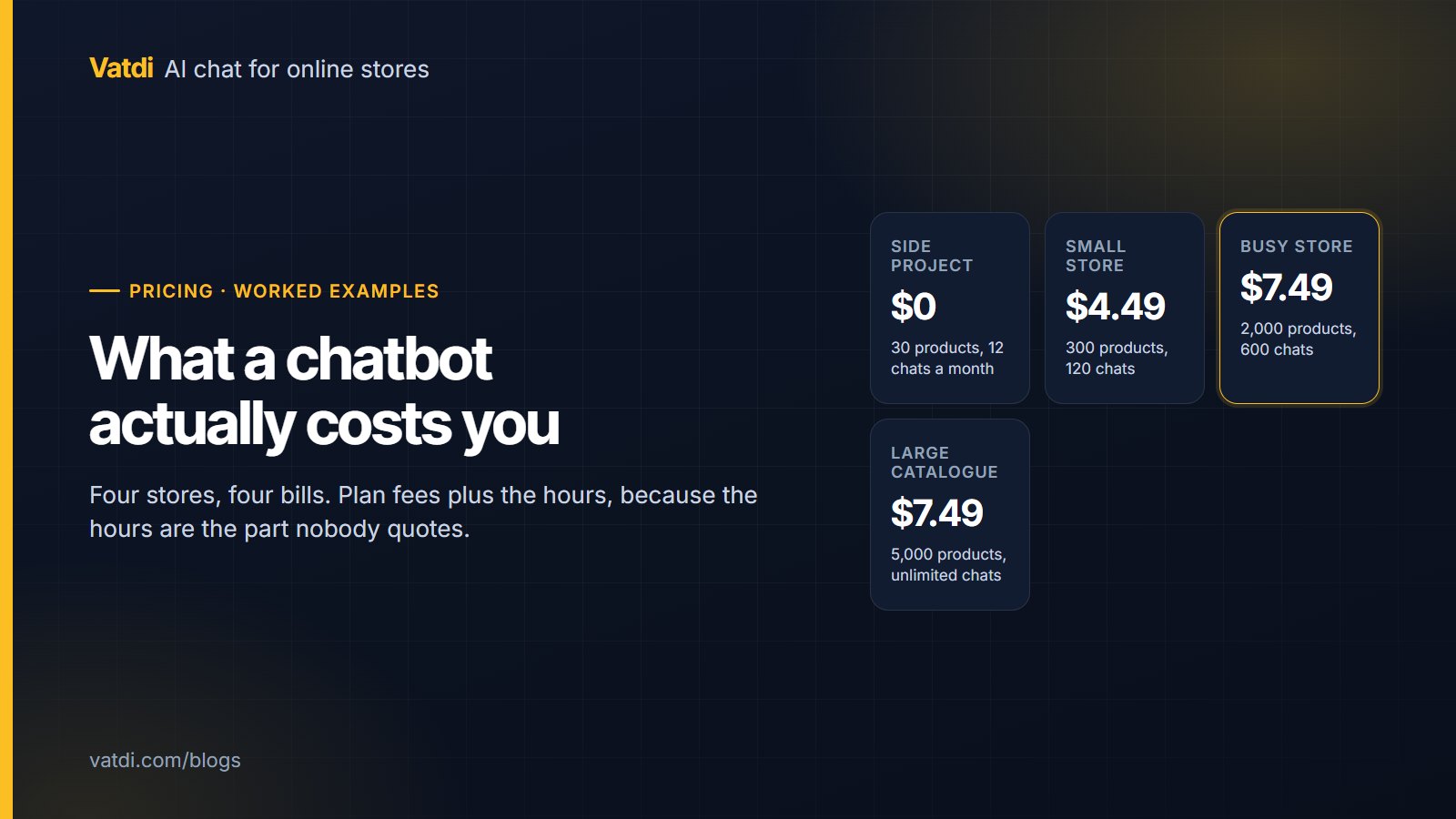
- The plan fee. As of September 2026 Vatdi is free for 15 conversations a month with every feature, $4.49 for 150 and $7.49 for unlimited; see pricing.
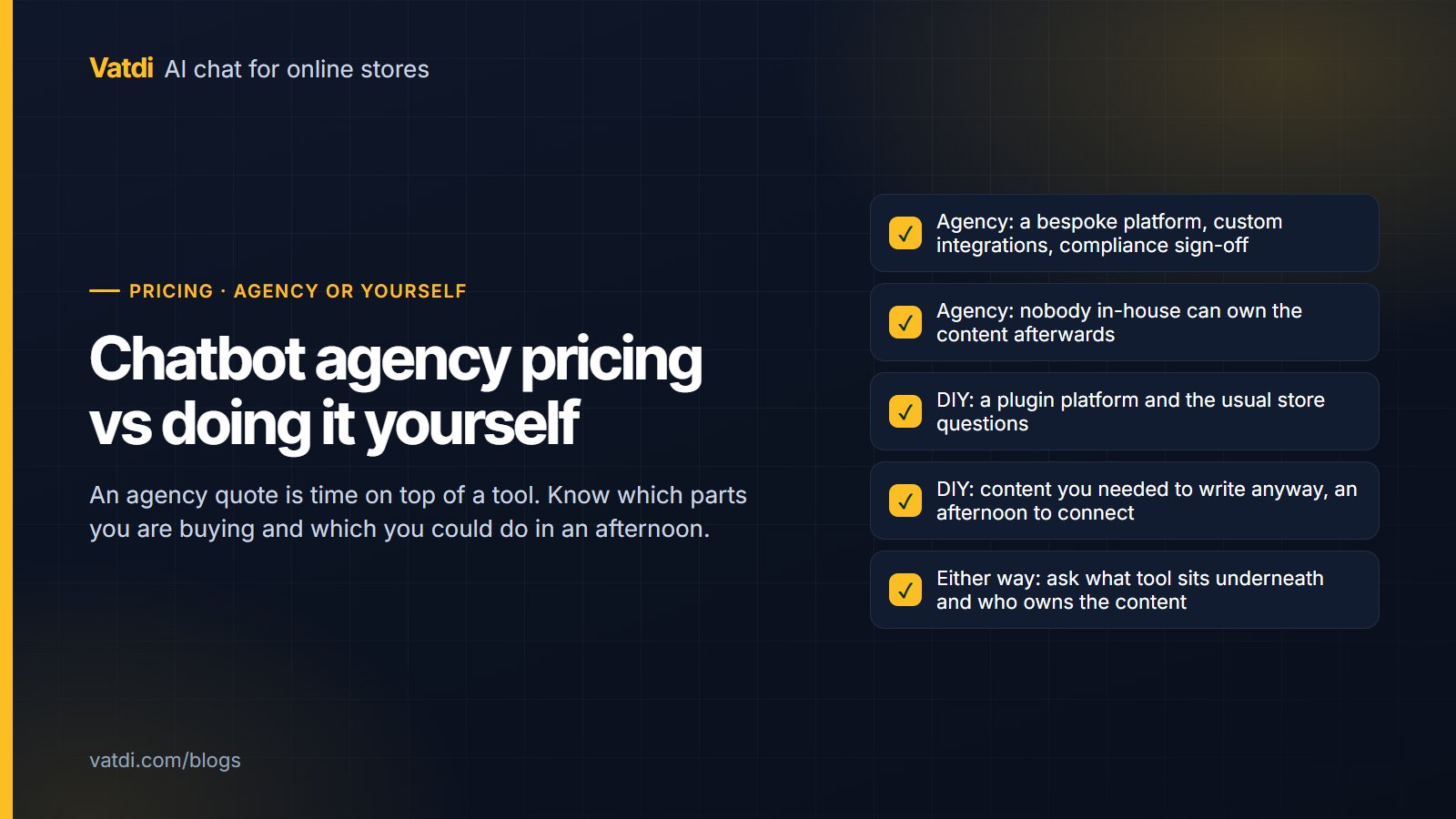
- Setup hours, typically an afternoon for a small store, most of it content you needed anyway.
- Weekly review, about ten minutes.
- Occasional re-testing after policy changes or plugin updates.
- Nothing else on a plugin platform: no developer, no integration project.
Worked totals for four store sizes are in four worked chatbot cost examples. On a metered plan the cost side is less predictable, which is itself a factor in the calculation; the units are compared in chatbot pricing models explained.
Why published ROI claims rarely transfer
Three reasons. They usually assume a cost per ticket drawn from contact-centre economics, which does not describe a store owner answering messages between other tasks. They often use containment as the success measure, which counts the frustrated customer who gave up alongside the satisfied one. And they are calculated on stores with different question mixes, catalogue sizes and traffic patterns from yours. Treat any figure in a vendor case study as one store's experience rather than a forecast for yours, and build your own version from the three measures above. Our own aggregate conversation figures, published with the method stated so they can be read as one data set rather than a law, are in our ecommerce chatbot statistics.
The costs that do not appear in the calculation
Two are worth naming because they are real and usually omitted. The first is the risk of a bad answer: a confident wrong statement about delivery or returns can cost a refund and a review, which is why the guardrails and the negative-case testing matter more than any efficiency gain. Price that risk as content discipline rather than as a number, and it stays close to zero. The second is attention: the weekly ten minutes is small but not free, and a store that skips it ends up with an assistant quoting last quarter's policy. Both costs are manageable, and both are more predictable than the benefits, which is unusual and worth exploiting when you make the case internally.
Why the mechanism matters to the sums
A grounded assistant answers from your pages rather than from general knowledge, the approach described in Lewis et al., 2020. That is why the content work dominates both the cost and the benefit: the same edit that lets the assistant answer precisely also improves the page for readers and for search, which Google sets out in its guidance on helpful content. When you price the afternoon spent on policy pages, credit it to both columns rather than only to the chat project, because that is where the value actually lands.
A sensible review rhythm
Do the count once after the first full month, then again at three months, and stop. A quarterly glance is enough after that, because the answer for a small store is usually obvious by then: either the assistant is handling a meaningful share of repetitive questions, in which case a few dollars a month is trivially justified, or it is not, in which case the diagnosis is almost always missing content rather than a failed tool. The weekly loop that fixes that is in the six chatbot KPIs worth watching, and the setup order in the implementation checklist.
Frequently asked questions
How do I calculate chatbot ROI?
Count conversations answered without a person, subtract the ones that would never have reached you, estimate the minutes each would have taken and multiply by what your time is worth. Then note pre-purchase questions answered out of hours separately, as a judgement rather than a calculated figure.
Why not use an ROI calculator?
Because most multiply an assumed deflection rate by an assumed cost per ticket, neither of which describes your store. The inputs are the answer, so the output tells you what the vendor assumed rather than what you will experience. Your own month of conversations is better evidence.
Can I measure the sales effect?
Not precisely without attribution modelling that is disproportionate at this size. What you can do is count pre-purchase questions answered outside working hours and decide what share of those shoppers would otherwise have waited. State it as a judgement, which keeps the estimate honest.
What is the most underrated benefit?
The unanswered-question list. Every recurring gap it names was already costing you conversations invisibly, and fixing it improves the storefront for every visitor including those who never open the chat window. Record what you fixed, because that list is the clearest evidence of value.
How long before it pays for itself?
On a flat plan of a few dollars a month, usually within the first month for any store with regular repetitive questions. The larger investment is the afternoon of content work, and that pays back regardless of the assistant because clearer policy pages reduce email and support conversion.
What if the numbers are disappointing?
Read the unanswered-question list before concluding anything. A disappointing result almost always means the assistant lacks the content to answer what people ask, which is a fixable content problem rather than a verdict on the approach. Check placement too, since an invisible widget produces no conversations at all.