A chatbot welcome message has one job: tell the visitor what they can ask. Most stores use it to say hello, which sets no expectation and answers nothing. One sentence naming the scope raises the number of useful conversations, because a shopper who is unsure whether the window can help usually closes it rather than finding out.
The anatomy of a good opening
| Element | Example | Why |
|---|---|---|
| Scope | "delivery, returns, sizing or your order" | Tells the visitor what is in range, and implies what is not |
| Length | Under twelve words | Read at a glance on a phone |
| Register | Plain, no exclamation marks | Enthusiasm reads badly to someone with a problem |
| Identity | Stated when asked, not performed up front | Honest without making the greeting about itself |
| Availability | Named when a person is not around | Prevents a promise nobody can keep |
Examples for each situation
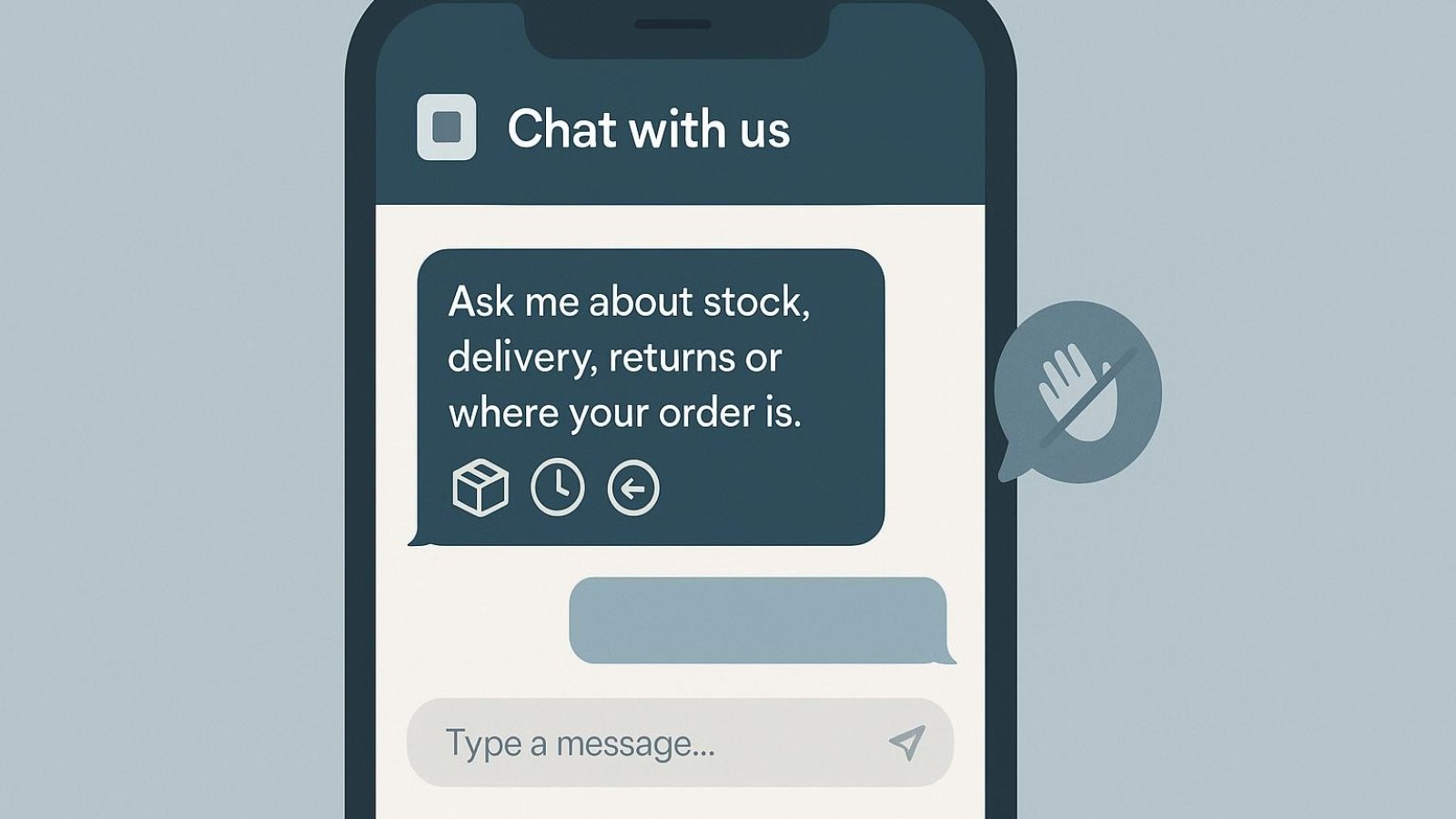
- General: "Ask me about delivery, returns, sizing or your order."
- Product page: "Questions about this product, delivery or returns? Ask away."
- Checkout: "Questions about delivery times, payment or returns before you order?"
- Out of hours: "Ask me anything about delivery, returns or your order. The team is back at 9am Monday."
- Busy period: "Ask me about delivery dates, returns or your order. Replies from the team may be slower this week."
- Service business: "Ask about prices, availability or how we work."
- Asked directly: "I'm an assistant. I answer from this store's pages and order data, and I can pass you to the team."
Every one of these names something concrete. The general version works on most sites; the page-specific ones work better where you can set them, for the same reason that quick replies should match the page, as covered in chatbot quick replies.
Greetings worth deleting
- "How can I help you today?" The visitor does not know what you can help with, which is the thing they needed told.
- "I'm here 24/7!" True of the assistant, misleading about the team, and it invites disappointment at midnight.
- "Hi, I'm Aria, your virtual shopping companion." A persona introduction spends the one sentence you had on itself.
- "Let me know if you need anything." Passive, and it puts the burden back on the visitor.
- Anything with two exclamation marks. Cheerfulness reads as indifference to someone chasing a parcel.
Saying it is an assistant
Do it when asked, plainly, in the language of the conversation, rather than announcing it in the greeting. Customers accept an assistant; what they resent is discovering they were misled. A good reply names what it is, what it draws on and what it can do next: "I'm an assistant. I answer from this store's pages and order data, and I can pass you to the team Monday to Friday, nine to six." That sentence closes the question rather than opening a philosophical one. The wider rules are in chatbot guardrails for online stores.
Out of hours, honestly
The greeting is where most stores accidentally lie. "We usually reply in a few minutes" is fine at 11am on a Tuesday and false at midnight, and the customer who reads it then remembers it. Either vary the message by agent hours, or write one that is true at all times by separating the assistant from the team: the assistant answers now, the team replies during stated hours. Most store conversations happen outside office hours, which is precisely why this sentence matters; our own figures across real stores, with the method stated, are in our ecommerce chatbot statistics.
Proactive messages
A greeting that opens itself is a different thing from a greeting that waits. On a product page, a panel expanding over the image after three seconds interrupts the decision it was meant to help, and the usual result is a dismissal rather than a conversation. If you use a proactive message at all, keep it to one page type where you have a specific reason, such as a checkout error page, and keep it small. The general advice is to stay closed by default and make the launcher clearly visible instead, which is also covered in ten chatbot mistakes stores keep making.
Matching the greeting to what you can actually answer
The scope you name is a promise, so name only what your content supports. A store without live order lookup should not list order status among the topics, however common the question, because every visitor who taps it gets a disappointment in the first exchange. The same applies to sizing on a store whose size chart is an image, or to availability where stock is not synced. Write the greeting last, after the content and the connections are in place, and revise it when either changes. A narrower greeting that keeps its promises produces better conversations than a broad one that cannot, and it is far easier to widen later than to recover from a first impression that the assistant does not know anything.
Testing the sentence
Read it aloud as a customer in three states: browsing casually, mid-purchase, and annoyed about a late parcel. A greeting that works in all three is the right one, and enthusiasm usually fails the third. Then check it in your other languages if you sell across borders, since a translated greeting can shift register in ways that are invisible to you; the approach is in multilingual chatbot setup. The retrieval design that determines what the assistant can actually deliver on those promises is described in Lewis et al., 2020, and the plain-language guidance in Google's developer documentation style guide applies neatly to widget copy.
Where to set it
In Vatdi the welcome message, quick replies and agent hours are widget settings, editable per store and translatable, on every plan; allowances are on the pricing page as of September 2026. Write one sentence, test it in the three states above, and leave it alone. The launch sequence around it is in the implementation checklist. Revisit the sentence only when your hours, your scope or your evidence changes, rather than as a matter of routine.
Frequently asked questions
What should a chatbot welcome message say?
What the visitor can ask, in one sentence under twelve words. Naming three or four topics, such as delivery, returns, sizing and order status, tells them what is in range and implies what is not. That is more useful than any greeting, however friendly, because it converts uncertainty into a question the visitor can actually ask.
Should it say it is a bot?
When asked, clearly, and in the language of the conversation. Announcing it in the greeting spends your one sentence on the assistant rather than on the customer. What matters is never claiming to be human, since being misled is what people actually object to.
Should the chat open automatically?
Usually not. A panel expanding over a product image interrupts the decision it was meant to help, and most visitors dismiss it. Stay closed by default with a clearly visible launcher, and reserve proactive messages for a specific page where you have a reason.
How do I handle out-of-hours in the greeting?
Separate the assistant from the team: the assistant answers now, the team replies during stated hours. That sentence is true at every hour, which avoids the common mistake of promising a fast reply at midnight and being remembered for it.
Can I use a persona name?
A name is fine; an introduction is the cost. If you use one, keep it to a word rather than a sentence, and make sure the greeting still names what the assistant can answer. Persona detail rarely changes outcomes and always occupies space that scope would use better.
How often should I change it?
Rarely. Change it when your hours change, when a busy period needs a different expectation, or when the questions people type show the scope is wrong. Frequent rewriting prevents you from learning whether the current version works, since you need a stable sentence and a month of conversations before any comparison means anything.